Why can electronic scale molds meet the special needs of the industry
The reason why electronic scale molds can meet the special needs of the industry is closely related to their customized design for the characteristics, functional requirements, and production scenarios of electronic scale products. The following analysis will focus on the characteristics of electronic scale products, mold technology requirements, and industry application scenarios:
The reason why electronic scale molds can meet the special needs of the industry is closely related to their customized design for the characteristics, functional requirements, and production scenarios of electronic scale products. The following analysis will focus on the characteristics of electronic scale products, mold technology requirements, and industry application scenarios:
1、 The special requirements of molds for the characteristics of electronic scale products
1. Forming requirements for high-precision structural components
Precision of sensor installation location
The core components of electronic scales, such as weighing sensors and strain gauges, need to be installed on grooves or brackets with high dimensional accuracy (with tolerances usually within ± 0.05mm). The mold needs to be precision machined (such as electric discharge, slow wire cutting) to ensure the flatness and hole spacing accuracy of the installation position, avoiding uneven force on the sensor caused by mold errors and affecting the accuracy of weighing.
Thinning and Lightweight Design
The shell thickness of household electronic scales and portable scales is often less than 2mm, and strength (such as drop resistance) needs to be taken into account. The mold needs to use thin-walled injection molding technology (such as hot runner technology) to control the uniformity of melt flow and avoid defects such as shrinkage and warping. At the same time, surface treatment of the mold cavity (such as hard chrome plating) is used to improve the wear resistance of the mold and ensure consistency in mass production.
2. Function integration and assembly compatibility
Correct design of circuit board slots and harness holes
The mold needs to form circuit board slots, wire harness through holes and other structures on the shell and base, ensuring that the assembly gap with electronic components (such as display screens, buttons, and connecting wires) is ≤ 0.1mm, to avoid component loosening or short circuits caused by mold deviation (such as circuit board shaking caused by loose card slots).
Waterproof and dustproof sealing structure
Industrial electronic scales (such as food processing and chemical scenes) need to have a protection level of IP65 or above. The mold needs to form precise sealing ring grooves (such as trapezoidal grooves and dovetail grooves) at the edge of the shell. The size tolerance of the sealing groove is controlled by the mold accuracy (± 0.03mm) to ensure that there is no gap after the installation of the sealing strip and meet the waterproof testing requirements.
2、 Customized design of mold technology for industry demand
1. Special selection of materials and structures
Corrosion resistance of mold materials
If electronic scales are used in the food and medical industries, the shell is often made of food grade ABS or PP materials, and the mold needs to be made of corrosion-resistant steel (such as S136H stainless steel), and the mold cavity needs to be mirror polished (roughness Ra ≤ 0.2 μ m) to prevent material residue from breeding bacteria, while also being easy to clean and complying with industry hygiene standards (such as FDA, ISO 13485).
Multi slider and inclined top structure to cope with complex shapes
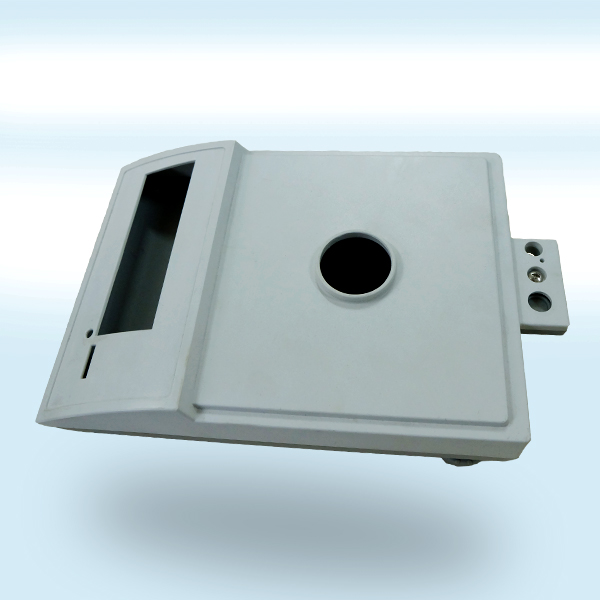
The outer shell of an electronic scale may include inclined surfaces and inverted structures (such as hooks for battery compartment covers), and the mold needs to be designed with multiple sets of sliders or inclined top mechanisms (such as oil cylinder driven sliders) to achieve one-time molding of complex shapes. For example, the curved display screen frame of the kitchen scale needs to be demolded through inclined top core pulling, and the mold design needs to correctly calculate the inclined top angle (usually ≤ 15 °) to avoid scratching the product surface during demolding.
2. Production efficiency and automation adaptation
Multi cavity mold and hot runner system
Commercial electronic scales (such as supermarket price scales) have a high demand, and molds often adopt multi cavity designs such as 16 cavity and 32 cavity, combined with hot runner technology (temperature control accuracy ± 1 ℃), to reduce gate waste and improve production efficiency (single cycle time can be shortened to less than 20 seconds). At the same time, the mold needs to be connected to the automated production line (such as mechanical arm picking and online detection), so positioning pins and sensor installation holes need to be set on the mold to ensure the accuracy of picking and production stability.
Quick mold change and maintenance design
Electronic scales are updated quickly (such as appearance changes and functional upgrades), and standardized mold frames (such as LKM and DME specifications) need to be used for molds. They can be quickly positioned through guide columns and sleeves, combined with hydraulic or pneumatic mold changing devices, to achieve mold replacement within 2 hours and reduce production line downtime costs. In addition, vulnerable parts such as ejector pins and slider wear-resistant blocks are designed to be detachable for easy maintenance and replacement, extending the service life of the mold.
3、 Special needs and mold response in different industry scenarios
1. Household and commercial electronic scales
Aesthetic appearance and cost control
Household scales (such as weighing scales) pay attention to the surface texture of the shell (such as matte, high gloss effect), and the mold needs to be processed with leather texture (such as EDM discharge machining texture) or in mold decoration (IMD) technology to achieve one-time molding of patterns and colors, avoiding subsequent spraying processes. At the same time, in order to reduce costs, the mold adopts a simplified design (such as a two plate mold structure), reduces processing time, and is suitable for mass production.
2. Industrial and medical electronic scales
High strength and impact resistance
The shell of industrial electronic scales (such as storage scales) needs to withstand forklift crushing and heavy object impact. The mold needs to ensure uniform product wall thickness (such as 3-5mm), and a reinforced rib forming structure (such as cross ribs and honeycomb ribs) should be designed in the mold. The position of the ribs should be optimized through mold flow analysis to avoid stress concentration and cracking. Medical scales (such as baby scales) require molds to have no dead corners and be easy to clean, so a fully sealed mold cavity design is adopted to prevent material residue.
3. Electronic scales for special environments
High temperature and low temperature resistance performance
Electronic scales used in cold storage and high-temperature workshops should be made of low-temperature resistant PC or high-temperature resistant PPS materials. The mold should be equipped with a temperature control system (such as a mold temperature machine heating to 120 ℃ or above) to ensure uniform melting of the material. At the same time, the mold cooling water channel should be optimized (such as conformal cooling) to control the internal stress of the product after molding and prevent low-temperature cracking or high-temperature deformation.
4、 Industry standards and compliance requirements
Metrological Certification and Safety Standards
Electronic scales are measuring instruments, and the mold must ensure that the product dimensions comply with relevant standards (such as GB/T 7724-2008), for example, the flatness error of the weighing platform is ≤ 0.1mm. During mold processing, the mold cavity dimensions need to be calibrated using a coordinate measuring machine (CMM). In addition, exported products must meet international standards (such as EU CE, US NTEP), and molds must ensure that the product structure does not affect sensor calibration, and there are no sharp edges or conductive hazards.
Environmental Protection and Recyclability
The EU WEEE directive requires that electronic device casings be recyclable, and mold design should avoid using inserts made of different materials (such as metal and plastic inserts) to facilitate later disassembly and recycling. At the same time, lead-free injection molding technology should be used, and mold temperature control should prevent harmful substances from being produced by material thermal decomposition.




 Home
Home
 Product
 Wechat
 Telephone